
NamUs vs NCIC: The Two Systems That Track Missing Adults, Explained
Two names come up in almost every missing-adult case, and families are rarely told what either one actually does. This guide separates them: what each system holds, who runs it, who can use it, and why a case should be in both.
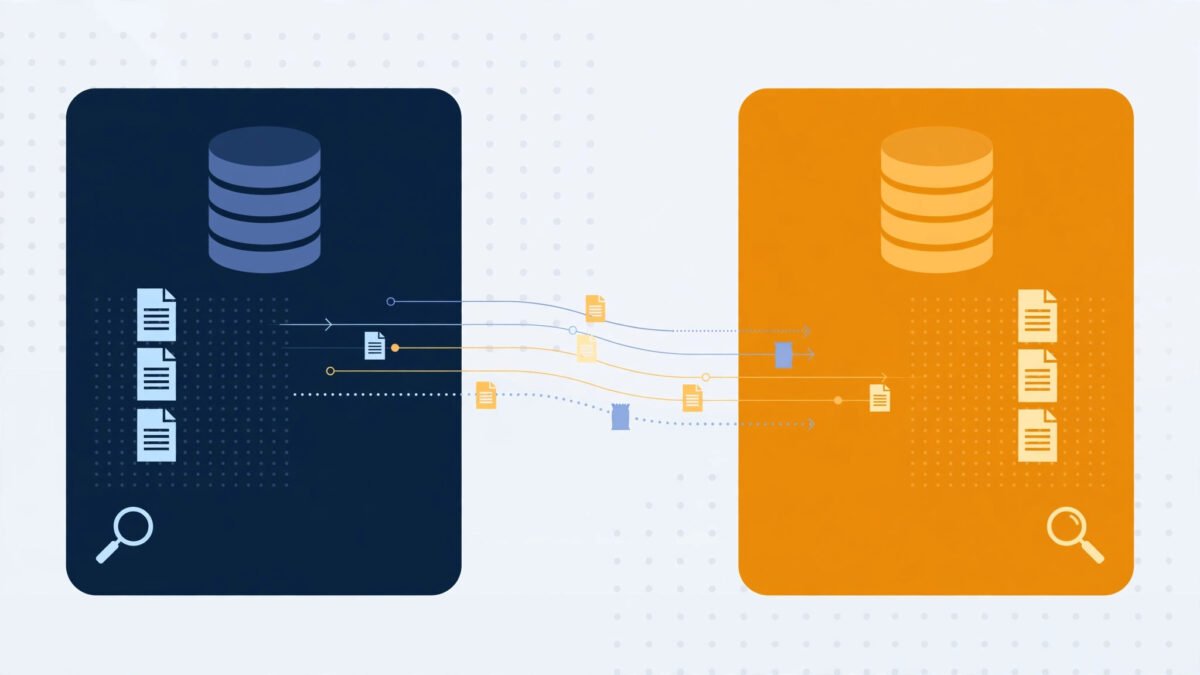
NamUs and NCIC are not the same system and they do not do the same job. NCIC is the FBI's database, entered by a law enforcement agency after a report is filed; NamUs is the National Institute of Justice's repository that families can search and enter cases into. We recommend a case be in both.
What is the difference in one paragraph?
NCIC is the FBI’s system. Records enter it through a law enforcement agency after a missing-person report is filed, when the entry criteria are met, and it has been running since 1975. NamUs is the National Institute of Justice’s system. It is the only national repository for missing, unidentified and unclaimed persons cases, according to the National Institute of Justice, and it is the only national database of its kind that allows limited access to the public. Families can search it and enter cases into it. The two systems hold different records, answer to different agencies, and serve different people. The confusion comes from the fact that a good missing-adult case ends up in both, and the family usually only hears about one of them.
The history explains the split. The FBI’s NCIC Missing Person File was implemented in 1975, according to the FBI’s 2024 statistics publication, and records in it are retained indefinitely until the person is located or the record is canceled by the entering agency. NamUs came much later. The National Institute of Justice began funding major DNA-technology efforts in 2003, expanded with an “Identifying the Missing Summit” in 2005, and created NamUs after a National Missing Persons Task Force identified the need. Its unidentified-persons database launched in 2007 and was later connected with its missing-persons database, according to the National Institute of Justice.
NamUs vs NCIC, side by side
The table below is this site’s own compilation, built only from the four primary sources listed at the end of the fact pack for this article: the National Institute of Justice’s NamUs pages, its September 2025 fact sheet, and the FBI’s 2024 NCIC statistics. No third-party summary was used. Where a cell says “not stated,” that is an honest gap in the sources opened for this article, not a guess.
| NamUs | NCIC | |
|---|---|---|
| Run by | National Institute of Justice, the research, development and technology office of the U.S. Department of Justice’s Office of Justice Programs | FBI; the contact is the FBI Criminal Justice Information Services Division, NCIC Operations and Policy Unit |
| Who can see it | Limited public access. Family members, volunteers, advocacy-group staff and the general public can search and view publicly visible information; professional users see sensitive data such as dental records and fingerprint cards | Law enforcement and criminal justice agencies query NCIC records; the FBI’s NCIC Investigative and Operational Assistance Group distributes monthly extracts to state points of contact and responds to nationwide statistics requests from law enforcement agencies and the media for public release |
| What it holds | Missing, unidentified and unclaimed persons cases, with forensic and biometric data for crossmatching | Missing-person records in six categories (Disability, Endangered, Involuntary, Juvenile, Catastrophe Victim, Other) plus unidentified-person records in three categories (Deceased, Living, Catastrophe Victim) |
| How a case gets in | Voluntary entry by law enforcement, family members and medical examiners; public entries are vetted with the investigating agency; 16 to 17 states require entry, and the sources differ on the number | Law-enforcement agency entry; mandatory for missing persons under 21 under 34 U.S.C. Section 41307(a); adult entry (21 and over) is based on circumstances |
| When it is used | Mainly cases with no investigative lead after 180 days; usable immediately where there is an immediate risk of death or injury | Entry categories apply at the time of the report; no time window is stated in the FBI publication |
| What it cannot do | Its cases do not necessarily reflect all missing, unidentified and unclaimed persons cases across the United States or in any one state | Its circumstance data covers only part of the file: the optional circumstances field was used in 48 percent of 2024 entries, and date of birth was omitted in 427 entries |
| Services beyond the database | Free forensic, investigative and analytical services, including DNA testing, fingerprint comparison, composite sketches, investigative genetic genealogy, case reviews and access to CLEAR investigation software | None listed in the FBI publication; it is a database and a statistics publication |
| Unidentified remains | Unidentified-person database launched in 2007 and connected to the missing-persons database; missing cases and unidentified remains are crossmatched | Unidentified Person File online since 1983; use is voluntary; 8,546 records were active at 31 December 2024 |
| Retention | Not stated in the sources opened for this article | Missing Person File: retained indefinitely until the person is located or the record is canceled by the entering agency. Unidentified Person File: retained indefinitely unless removed by the entering agency |
| Scale in 2024 | No current case count is stated in the sources opened for this article | 533,936 records entered in 2024; 93,447 active at 31 December 2024; of those, an estimated 67,954 were adults 18 and over, which is 72.7 percent, calculated from the FBI’s own figures |
| Families’ role | Families can enter cases, track cases, provide DNA samples, and search publicly visible information | Not stated in the FBI publication |
Who runs them, and who can actually use them?
NamUs is administered by the National Institute of Justice, and that matters because it shapes what the system is for. It is the nation’s only centralized federal program offering free forensic, investigative and analytical services to resolve long-term missing and unidentified cases, according to the National Institute of Justice. Its public users are family members, volunteers, staff from missing-person advocacy groups and the general public. They may enter new missing-person cases, track cases, and search and view all publicly visible information. Every public entry is vetted with the appropriate investigating agency before it becomes publicly visible.
Professional NamUs users, meaning law enforcement, register separately. They can search and view sensitive information such as dental records and fingerprint cards, and they can add, edit and track cases through their authorized permissions. They also get access to the secure database and to CLEAR, the Consolidated Lead Evaluation and Reporting investigation software, through NamUs analytical staff. NamUs also employs a liaison to coordinate with the FBI’s Violent Criminal Apprehension Program and with NCIC, to ensure case data is recorded and concordant in all federal repositories. That coordination is confirmed. Whether the records are automatically synchronized is not stated in the sources opened for this article, and this guide does not claim it.
NCIC works differently. Its Missing Person File has six entry categories: Disability, Endangered, Involuntary, Juvenile, Catastrophe Victim and Other. Five of them apply to a person of any age who meets the stated condition. The Juvenile category covers a person not declared emancipated under state law who meets no other category’s criteria. Agencies are required to enter records for missing individuals under age 21, under Title 34, U.S. Code, Section 41307(a). That age was raised from under 18 to under 21 in 2003, when Suzanne’s Law amended the Crime Control Act of 1990, according to the FBI’s publication. For adults aged 21 and over, entry is based on circumstances, not age. Adults aged 18 to 20 are covered by the requirement to enter records for everyone under 21. The Other category covers a person for whom there is a reasonable concern for safety.
What do the numbers say?
The FBI’s 2024 figures are the clearest picture available, and they contain a gap worth looking at directly. During 2024, 533,936 missing-person records were entered into NCIC, and 537,446 records were purged in the same period, for reasons including the subject being located, returning home, or the record being determined invalid. At 31 December 2024, NCIC held 93,447 active missing-person records. Of those, 25,493 were juveniles under 18, which is 27 percent, and 34,256 were under 21, which is 37 percent.
Subtract the under-18 figure from the active total and the adult number can be estimated: 93,447 minus 25,493 is 67,954 adults aged 18 and over, or 72.7 percent of all active records. That is a calculation from the FBI’s own published figures, not a number the FBI prints. One assumption sits inside it: the FBI reports the 427 records with no date of birth only for entries, not for the active file, so the subtraction assumes no active record lacks a date of birth. Now compare it with entries. Of the 533,936 records entered during 2024, 349,557 were ages 0 to 17 and 183,952 were ages 18 and over. Adults were 34.5 percent of entries but an estimated 72.7 percent of what was still open at year end. Juveniles were 65.5 percent of entries but 27.3 percent of active records.
The gap between those two shares is real and it is sourced. What the FBI publication does not say is why it exists, and this guide does not fill that hole with a theory. One related fact is worth stating with its limits attached. The circumstances field in NCIC is optional and has been available since 1999. Of the 533,936 records entered in 2024, it was used in 258,849, or 48 percent. Where it was used, 245,818 entries, or 95 percent, were coded Runaway; 2,366 were abducted by a non-custodial parent; 293 were abducted by a stranger; and 10,372 were adult federally required entries. A field in which one code accounts for 95 percent of the filled-in records carries little information about why adults disappear, and this guide does not present those breakdowns as a picture of adult cases.
The unidentified-persons side of NCIC is smaller and older. The Unidentified Person File came online in 1983, its use is voluntary, and it held 8,546 records at 31 December 2024. During 2024, 861 were entered, of which 647 were deceased, 16 were catastrophe victims and 198 were living persons, while 837 were canceled or cleared.
What about the 180 days?
The 180-day figure is the most misunderstood number in this subject, so it deserves its own section. NamUs says its resources mainly benefit cases that have failed to generate an investigative lead after 180 days, and it encourages use of the program for any case whenever circumstances indicate an immediate risk of death or injury. That is a statement about when NamUs is most useful. It is not a waiting period, and this guide does not write it as one. Nobody should wait 180 days before registering a case with NamUs.
The same care applies to the state-mandate number. The National Institute of Justice’s overview page says 17 states require law enforcement to enter information into NamUs. Its September 2025 fact sheet for medical examiners and coroners (NCJ 310743) says 16 states require entry of missing-person cases, and four states require agencies to enter both missing and unidentified persons. This guide states it as 16 to 17 states, because the sources differ. The two figures may count different things, but the sources do not say that, and this guide does not present it as the explanation.
Which one should a family use?
Both, and the order is straightforward. The police report comes first. Records enter NCIC through a law enforcement agency after a missing-person report is filed, when the entry criteria are met. The New York Division of Criminal Justice Services advises families to request that the information be entered into the FBI’s NCIC Missing Person File. Ask for the report number, and note the NCIC number, which is usually recorded on the agency’s report. Then register the case with NamUs. NamUs is most useful for cases with no investigative lead after 180 days, and for any case where there is an immediate risk of death or injury. Registration is open to the public, the entry is vetted with the investigating agency, and the case becomes searchable by anyone looking for it.
NamUs is also where the free help lives. Its services include DNA testing, fingerprint examination and comparison, odontology charting and comparison, anthropology, tattoo image enhancement and searching, composite sketches, investigative genetic genealogy, and comprehensive case reviews by a team of law enforcement professionals, medicolegal death investigators, analysts and forensic scientists. It works with the FBI, U.S. Customs and Border Protection, the Department of Homeland Security, the Department of Veterans Affairs, the Bureau of Indian Affairs Missing and Murdered Unit, and the National Archives. It supports cases regardless of age, racial or ethnic affiliation, or biological sex, including missing migrants and foreign nationals whose last known location may have been in the United States. For juvenile cases it collaborates with the National Center for Missing and Exploited Children.
One limit should stay in view. NamUs itself warns that its cases do not necessarily reflect all missing, unidentified and unclaimed persons cases in the United States or in any one state. Entry is voluntary except where states mandate it. A case that is never entered into NamUs does not exist in NamUs, and no database can find a person nobody reported. That is why the first step in the companion guide, How to Report a Missing Adult in the US, is a police report, and why the numbers guide, How Many Adults Go Missing in the US, explains what the national counts actually measure.