How DNA Finds Missing Adults: Toothbrushes, Family Swabs, CODIS and Genetic Genealogy
When someone goes missing, the police may ask for a toothbrush, a cheek swab from the family, or dental records. This guide follows each of those items through the lab, into CODIS, and, when nothing else works, into genetic genealogy, and explains what DNA can and cannot do.
DNA identifies a missing adult three ways: a direct profile from the person's own items, a family reference profile compared with unidentified remains, and, as a last resort, forensic genetic genealogy. Family profiles are searched only against unidentified remains, never against criminal databases, and the service is free through NamUs.
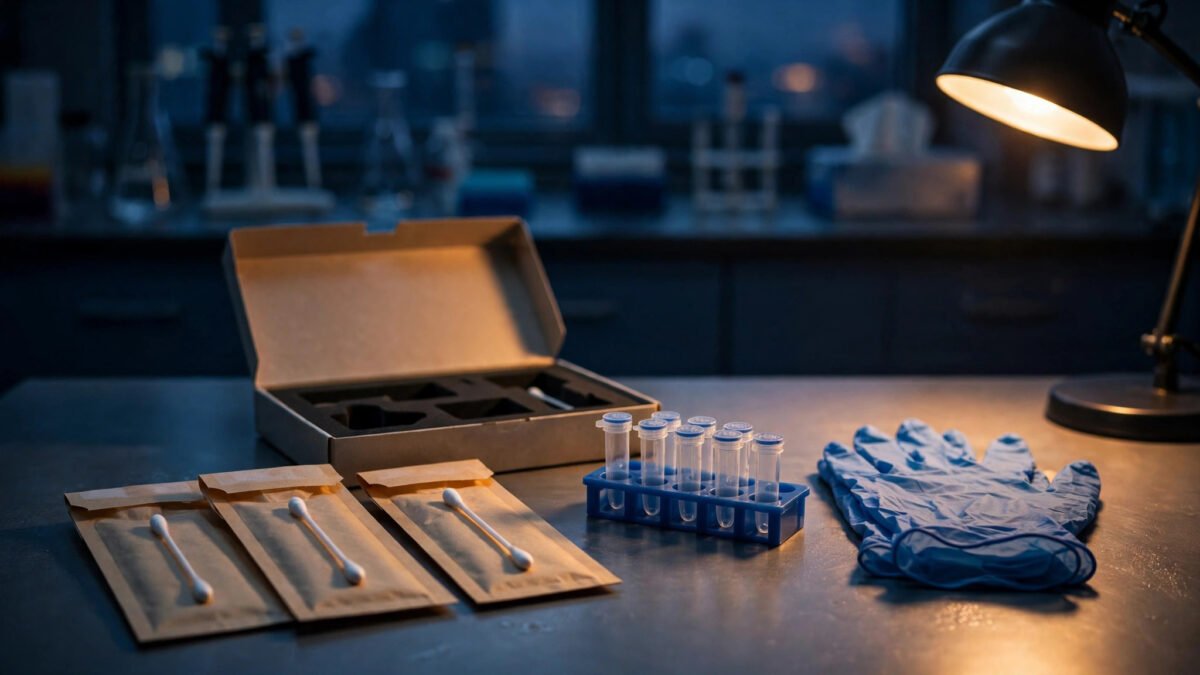
When the police ask for a missing adult’s toothbrush, it is not a strange request. It is the start of the most reliable identification system the United States has. A toothbrush used only by that person carries the missing person’s own DNA. A cheek swab from a parent carries a profile that can be compared with unidentified remains. And when neither of those works, a genealogy search can build a family tree from a single sample. This guide follows each of those items from the family’s hands to the lab, into the national database, and, when nothing else works, into genetic genealogy. It also says plainly what DNA cannot do, because the gap between what television shows and what the system does is where families get hurt.
Three routes carry DNA identification, and they are easy to confuse. A direct profile comes from the missing person’s own items. A family reference profile comes from close relatives and is compared only with unidentified remains. Forensic genetic genealogy builds a family tree from a sample and a genealogy database, and it is the last resort, with rules of its own. The table below sets out the three routes side by side.
| How DNA identifies a missing adult | Direct profile | Family reference | Forensic genetic genealogy |
|---|---|---|---|
| What is compared | The missing person’s own DNA, from a toothbrush, razor, or tissue sample, against unidentified remains | A relative’s DNA against unidentified remains | A sample’s SNP profile against genealogy databases |
| Who may use it | The investigating agency, through an accredited laboratory | The investigating agency, with the family’s signed consent | Law enforcement, only after CODIS and leads have failed and a prosecutor agrees |
| What it produces | A CODIS match, which is a lead the laboratories must verify | A kinship association, which is a lead the laboratories must verify | An investigative lead, never an arrest on its own |
| The key limit | A match needs a corresponding unidentified-remains profile already in the system | Family profiles are searched only against unidentified remains, never against criminal databases | Its results cannot be uploaded to CODIS, and it may be used only for unsolved violent crime or unidentified remains of a suspected homicide victim |
What the police will ask you for
The first request is usually for the missing person’s own things. The Indiana State Police list is specific: items used solely by the missing person, a toothbrush, hairbrush, razor, watch, or unlaundered undergarments, or items collected directly from the missing person, biopsy samples or baby teeth, should be obtained by the investigating officer and submitted to a regional laboratory for analysis. At the University of North Texas Center for Human Identification, a toothbrush, razor, oral appliance or dentures, and baby teeth may be acceptable as direct reference samples, depending on known usage and storage conditions. Clothing is not accepted as a direct reference sample there, so a shirt the person wore is not a substitute for the toothbrush.
The second request is for the family’s DNA. Family samples are collected by the investigating officer and submitted to a regional laboratory with the completed Family Reference Sample forms. NamUs states the rule plainly: a family reference sample must be collected by a law enforcement officer, medical examiner, coroner, or other medicolegal investigator, and all requests must come with a completed DNA Sample Collection Form. A family member cannot collect or submit his or her own DNA sample for profiling and upload to CODIS. All samples must be collected by criminal justice personnel who verify the donor’s identity, collect the samples, and contact their assigned NamUs Regional System Administrator to request testing. Do not mail in a swab you took yourself. It will not be accepted.
Close relatives for a family reference sample are biological parents, children, and full siblings. First-degree relatives, a parent, full sibling, or child, are the most beneficial for Short Tandem Repeat DNA comparisons. Second-degree relatives, a half-sibling, aunt, uncle, or grandparent, may be useful for limited STR comparisons, as well as for Y-STR or mitochondrial DNA comparisons, but first-order relatives are always preferred when available. At least two family members’ DNA profiles should be collected for every missing person case, so that proper searching can take place in CODIS and potential associations can be identified, and if no first-degree relatives are available, additional family reference collections may be required. The University of North Texas Center for Human Identification prefers a minimum of two biological relatives, most preferred the mother, father, and child or children of the missing person, with full siblings acceptable and half siblings, aunts and uncles, and grandparents least preferred. A maximum of three family references are typically tested, to make the most of limited funding and resources, and family references not necessary for kinship analysis are archived without testing.
Two more things come with the request. Family members are asked to sign a form consenting to their DNA profile being placed in a database. And if available, dental and medical records should be obtained for submission to NamUs through the investigating officer, along with fingerprints. The Georgia Bureau of Investigation tells families to have as much information as possible ready, such as a physical description, the circumstances surrounding the last time the person was seen, and the availability of dental records, medical records, or family members to provide DNA reference samples. One reassurance comes from the Indiana State Police, in their own words: “This type of DNA testing gives no personal or medical information.”
What NamUs does for free, and how to ask
NamUs is the only national repository for missing, unidentified, and unclaimed persons cases, and it describes itself as the nation’s only centralized federal program that offers free forensic, investigative, and analytical services to resolve all long-term missing and unidentified cases. Its forensic services include odontology charting and comparison, fingerprint examination and comparison, anthropology, tattoo image enhancement and searching, composite sketches, traditional DNA testing, and investigative genetic genealogy.
The DNA testing itself covers short tandem repeat, Y-STR, and mitochondrial DNA analyses for missing and unidentified persons cases. NamUs subcontracts with accredited, NDIS-participating laboratories to allow for CODIS upload, and it also provides advanced genetic technologies, including biogeographic ancestry determination and whole genome sequencing coupled with forensic genetic genealogy. The National Institute of Justice funds nuclear DNA testing, including Y-STR and mitochondrial DNA analyses, for missing and unidentified person cases from across the country, partnering with recognised ISO-accredited CODIS laboratories capable of developing and uploading mitochondrial DNA profiles. The National Institute of Justice reported in 2009 that agencies may have free DNA testing through the University of North Texas Center for Human Identification, and that it provides family reference-sample kits, at no charge, to any United States jurisdiction, so that family members’ DNA can be collected safely and effectively.
To request DNA testing, the investigating agency visits the NamUs Contact Us page and selects “Biometric Support” in the Nature of Inquiry dropdown menu. A DNA Sample Collection Form is provided for criminal justice personnel. Our guide on how to search NamUs walks through the three databases where a missing person’s case can sit. The service is framed by one timing point that matters for expectations: NamUs resources primarily benefit cases that have failed to generate an investigative lead after 180 days, though NamUs encourages use of the program for any case whenever circumstances indicate an immediate risk of death or injury. This is not a first-hours service. It is a long-case service, and it is free, for cases across the nation regardless of age, racial or ethnic affiliation, or biological sex, including missing migrants and foreign nationals whose last known location may have been within the United States.
CODIS and NDIS: the three indexes that matter
CODIS is the Combined DNA Index System. NDIS is its national level, implemented in October 1998. All 50 states, the District of Columbia, the federal government, the United States Army Criminal Investigation Laboratory, and Puerto Rico participate in NDIS. The DNA Act, 34 U.S.C. section 12592, permits these NDIS categories: convicted offenders, arrestees, legal, detainees, forensic casework, unidentified human remains, missing persons, and relatives of missing persons. Our guide on NamUs vs NCIC explains how the two systems differ and why a case can be in one and not the other.
For a missing adult, three of those indexes do the work. Direct profiles from a missing person, derived from items such as toothbrushes or tissue samples, are uploaded to the Missing Person index. Profiles for unidentified decedents are uploaded to the Unidentified Human index. Profiles from family members are uploaded to the Relatives of Missing Persons Index. A DNA profile is one or two alleles at each of the 20 CODIS Core Loci, effective 1 January 2017. The 20 Core Loci were chosen because they are not in gene or protein coding regions, the parts of DNA the FBI’s own FAQ calls “junk DNA”, and they are not causative of, or indicative of, medical conditions. STR, Y-STR, and mitochondrial DNA profiles are accepted at NDIS, and Y-STR and mitochondrial DNA are only searched with missing-person-related indexes. For mitochondrial DNA, both hypervariable regions are required: HV1, positions 16024 to 16365, and HV2, positions 73 to 340. For missing-person records, all Core Loci must be attempted, additional technologies such as mitochondrial DNA and Y-STR should always be considered as appropriate, and a Pedigree Tree is strongly encouraged, with the most robust trees having at least one biological mother, father, or child.
The size of the system is public, but only in part, and the gap is worth stating plainly. As of June 2026, NDIS contains over 20,317,558 offender profiles, 6,448,070 arrestee profiles, and 1,487,942 forensic profiles. Those three published categories total 28,253,570 profiles: offender profiles are 71.9 percent, arrestee profiles 22.8 percent, and forensic profiles 5.3 percent. CODIS has produced over 808,813 hits, assisting in more than 784,252 investigations. Those are two separate measures, hits and investigations aided, not a success rate, and neither is a missing-persons figure. “Investigations Aided” covers all CODIS casework, overwhelmingly offender and forensic matches, and the FBI’s published statistics page does not break out counts for the missing-persons, unidentified-human-remains, or relatives-of-missing-persons indexes at all, neither in the national summary nor in the per-state tables. The public cannot see how many missing-persons DNA profiles CODIS holds. Only NDIS-participating laboratories may enter profiles into NDIS. Private laboratories cannot enter profiles, though they may partner with an NDIS-participating laboratory under the outsourcing rules. And CODIS generally stores no names or personal identifiers, though missing-persons records may include date-of-birth metadata. DNA data is confidential under the DNA Identification Act of 1994, and unauthorised disclosure carries a criminal penalty of up to $250,000.
What your family’s DNA is never searched against
This is the question families ask most, and the answer is written into the system. Family reference profiles are only searched against unidentified-person profiles at NDIS, and are released only to criminal justice agencies for identification purposes. Individuals who provide Family Reference Samples have their DNA profiles uploaded to the Relatives of Missing Persons index of CODIS, which is searched only against the Unidentified Human index of CODIS. Family reference profiles are not searched against any of the criminal indices, such as those containing profiles of convicted offenders or unknown suspects.
The consent rules are just as firm. Only DNA samples collected voluntarily from relatives of a missing person are eligible for searching in NDIS, under 34 U.S.C. section 12592(a)(4). Relatives must be willing to provide a DNA sample and sign a consent form in the presence of law enforcement, and the consent form documents the voluntary contribution and the sole purpose of identifying a missing person or recovered remains. Family Reference Samples not submitted by law enforcement with the appropriate documentation will not be accepted for entry into NDIS. Foreign nationals can be added to NDIS too: the DNA Act does not limit eligibility by nationality, and the sample must be collected in the presence of law enforcement with consent documentation.
A family reference profile remains in NDIS until the missing person is identified, the donor is determined not to be related, or the donor requests removal in writing. After a confirmed identification, the relatives’ profiles are removed, though they may remain if only partial remains were identified, to assist with future recoveries, and a donor may request removal in writing at any time. When a DNA association does come back, it goes to law enforcement and the medico-legal authority, and only the designated medico-legal authority can declare identity, through issuance of a death certificate.
Two more distinctions protect families from a common misunderstanding. Familial searching is not performed at NDIS and is not conducted at the federal level. A partial match is a moderate-stringency candidate match, not an exact match, and may indicate a close biological relative, but moderate-stringency matches have very low efficiency in locating true relatives. A partial match is not the same as a familial search. Eighteen states do conduct familial searching at the state level: Arizona, Arkansas, California, Colorado, Florida, Kentucky, Louisiana, Michigan, Minnesota, New York, North Carolina, Ohio, South Dakota, Texas, Utah, Virginia, Wisconsin, and Wyoming. Maryland and the District of Columbia prohibit it.
Forensic genetic genealogy: the last resort with rules
Forensic genetic genealogy is the analysis of a forensic or reference sample by a vendor laboratory to develop a genetic genealogy profile, and a search of that profile in a publicly-available open-data personal genomics database or a direct-to-consumer genetic genealogy service. It examines more than half a million single nucleotide polymorphisms, SNPs, which replace the STR DNA markers analysed in traditional forensic DNA typing. The policy states that Department of Justice laboratories do not analyse SNPs during forensic DNA casework. It differs from familial searching in two ways: it uses non-law-enforcement databases and different markers than the 20 CODIS markers, and it led to the identification of the Golden State Killer in 2018.
The rules around it are strict, and they are the point. Information and data derived from forensic genetic genealogy is not, and cannot be, uploaded, searched, or retained in any CODIS DNA Index. A genetic association from a genealogy search is used by law enforcement only as an investigative lead. A suspect shall not be arrested based solely on a genetic association generated by a genealogy service, and if a suspect is identified after a genetic association, STR DNA typing must be performed to confirm the match by manual comparison with the forensic profile previously uploaded to CODIS. It may be used only when the case involves an unsolved violent crime, homicide or sex crime, with the forensic sample from a putative perpetrator, or unidentified human remains of a suspected homicide victim. A prosecutor may authorise it for other violent crimes where the circumstances present a substantial and ongoing threat to public safety or national security.
Before it is used, all of the following must hold: the forensic profile was uploaded to CODIS and subsequent CODIS searches failed to produce a probative confirmed match, reasonable investigative leads were pursued, relevant information was entered into NamUs and ViCAP if ViCAP criteria are met, a designated laboratory official was consulted, and the prosecutor agreed. Investigators must identify themselves as law enforcement to the genealogy service, use only services that give explicit notice that law enforcement may use them, and configure settings, where possible, to prevent the profile from being viewed by other users. An investigative agency must seek informed consent from third parties before collecting reference samples for this work, unless case-specific circumstances give reasonable grounds to believe that asking would compromise the investigation. Covert collection is permitted only with prosecutor approval, and a search warrant is required before the vendor laboratory analyses a covertly collected sample. Samples and profiles collected for forensic genetic genealogy may be used only for law-enforcement identification purposes and must not be used to determine a predisposition for disease or any other medical condition or psychological trait. Third-party samples, profiles, and genealogy-service account information and data must be destroyed after use, subject to government information-retention schedules, if no arrest results, or after a judicial order if a prosecution follows. The Department of Justice interim policy that sets these rules was approved on 2 September 2019 and effective on 1 November 2019. The policy is internal guidance for Department of Justice components, not a law that binds every law enforcement agency. NamUs lists investigative genetic genealogy among its forensic services and offers whole genome sequencing coupled with forensic genetic genealogy as an advanced genetic technology, and the Colorado Bureau of Investigation lists “Genetic Genealogy: DNA Doe Project” among the resources on its Missing Persons Resource Page.
What it looks like in five states
In Georgia, identification methods for unidentified individuals may include visual identification, dental comparison, prior medical intervention, unique identifying marks, and DNA, and remains are retained by the medical examiner’s office “in a dignified manner until an identification is made.” Families are told to file a missing-persons report with their local police department and to have dental records, medical records, or family members available to provide DNA reference samples. A missing loved one can be registered with NamUs with or without an official missing-persons report, though creating a full NamUs case requires an active missing-person report with law enforcement, and NamUs provides resources and information about how to provide family reference DNA samples to be compared with unidentified remains.
In Colorado, the statute for unidentified remains, C.R.S. section 16-2.7-104, sets out the sequence. A person with custody of unidentified human remains shall immediately notify the coroner or medical examiner and the sheriff, police chief, or land managing agency official. If the coroner or medical examiner takes legal custody of unidentified human remains, the coroner or medical examiner shall make reasonable attempts to identify them, which may include photographs of the remains before an autopsy, dental or skeletal X-rays, photographs of items found with the remains, fingerprints, samples of tissue suitable for DNA typing, and samples of whole bone or hair suitable for DNA typing. The coroner or medical examiner shall enter information concerning the physical appearance and structure of the remains, including DNA typing information, into the National Crime Information Center database, or work with law enforcement to ensure it is entered. The coroner or medical examiner shall neither dispose of nor materially affect the remains before obtaining samples suitable for DNA identification and archiving, if possible, obtaining photographs, and exhausting all other appropriate identification steps. Until all available information concerning the physical appearance and structure of the remains is entered into NCIC, cremation or natural reduction of unidentified human remains is prohibited, under subsection 5, amended by Senate Bill 21-006, effective 7 September 2021. Colorado families are told not to get rid of personal items that may be of use to investigators, clothes worn often, important mail, toothbrush or hairbrush, and to talk with the investigating agency about how to provide DNA Family Reference samples, and to provide law enforcement with who the missing person’s dentist is. Our Colorado guide covers the state’s clearinghouse, the 8-hour rule, and the Senior Alert in full. A family reference involves providing a simple cheek swab with a Q-Tip. These references are then compared to DNA profiles of Unidentified Human Remains. If there is not a match, the family reference DNA profile is stored and compared to new cases. Ideally, two family reference samples are collected in each missing-person case, starting with the mother and father, and a reference sample can also be collected from siblings. The contact for this is Analyst Audrey Simkins, Audrey.Simkins@state.co.us, from the Bureau’s open house for families of missing persons on 1 November 2023 in Lakewood.
In Florida, the law puts a clock on DNA. If a missing child or missing adult has not been located within 90 days after the missing child or missing adult is reported missing, the law enforcement agency that accepted the report shall attempt to obtain a biological specimen for DNA analysis from the missing child or missing adult or from appropriate family members. That DNA requirement is contingent on federal funding, under subsection 8 of the same statute. The clocks around it are tight: within 2 hours of a credible adult missing-person report, the investigating agency must transmit the report to the Florida Crime Information Center and NCIC, and within 90 days it must transmit the report to NamUs. Those deadlines bind the investigating agency, not the state clearinghouse. Our Florida guide covers MEPIC, the Silver Alert, and the 2-hour rule in full.
In Indiana, all resources on the State Police missing-persons page are free of charge. DNA profiles generated from missing persons can be searched in CODIS. DNA profiles generated from close family members can be searched in CODIS, which compares them to Missing and Unidentified Person Indexes. DNA profiles generated from human remains can be searched in CODIS, which compares them to casework, offender, and Missing Persons Indexes. The State Police bulletin asks for approximately 1 square inch of tissue, and only when there is little or no decomposition, and, for bone or teeth, at least one bone sample of at least three inches in length, or one whole tooth with no fillings, with molars preferred. Preferred bone selections are sections of a femur, a metatarsal, or a patella.
In Texas, the Missing Persons program at the University of North Texas Center for Human Identification began in 2002, as a result of Texas Senate Bill 1304, which allowed the establishment of a missing persons DNA database at UNT Health Fort Worth, within the Center for Human Identification. The Center provides autosomal STR, Y-chromosome STR, and mitochondrial DNA sequence analysis, enters eligible DNA profiles into CODIS at the local, state, and national levels as permitted, and conducts comparisons between unidentified remains cases and family references through CODIS searching or through manual comparison as appropriate. Reports are issued to the investigating agency or medico-legal authority, and are not issued to courtesy collection agencies of family reference samples. The Center also runs a standalone Humanitarian DNA Identification Database for family reference samples from non-United States citizens, which has no connectivity to the FBI or any other NDIS-participating laboratory database. The Evidence Specialist contact is 1-800-763-3147, at UNT Health Center for Human Identification, 3400 Camp Bowie Boulevard, Fort Worth, Texas 76107.
Why DNA does not always bring an answer
A CODIS match is a lead, not an identification. Laboratories must exchange information to verify a match, and only the designated medico-legal authority can declare identity, through issuance of a death certificate. A match can only happen if the relevant profile is already in the system. Degraded and difficult samples are a recognised constraint: NamUs works with experts who specialise in degraded evidence and bone samples, and at the University of North Texas Center for Human Identification, burned remains and paraffin-embedded tissue samples are accepted only on a case-by-case basis, embalmed remains or samples of unknown origin from an unidentified person are not acceptable, hair is acceptable only if forcibly removed, and the skull is the least preferred skeletal element.
Time is the other constraint. Once the assigned NamUs Regional System Administrator has approved the case for DNA analysis and samples have been submitted to the assigned laboratory, the expected turn-around time is 120 calendar days, though factors may impact this timeline, including additional testing required due to sample type and quality. Behind that figure sits a much larger queue, and its scope needs stating plainly. At yearend 2020, publicly funded crime labs had a backlog of about 710,900 requests that had not been completed within 30 days of submission. Forensic biology casework accounted for 126,100 of those, 17.7 percent of the total. The forensic biology casework backlog was up 17 percent from yearend 2014 to yearend 2020, and the DNA databasing backlog was up 87 percent over the same period, with some labs suspending operations during 2020 for COVID-19, which partly accounted for the increase. In 2020, publicly funded crime labs received 3.3 million requests for service and completed 3.2 million. The total backlog rose 24.7 percent from yearend 2014, when it was 570,100, to yearend 2020, but it was 20.6 percent lower than yearend 2009, when it was 895,500. These are counts of all crime-lab requests, controlled substances, toxicology, DNA databasing, forensic biology, and others, not missing-persons DNA specifically, and this guide does not present them as a missing-persons backlog. No published figure for a missing-persons-specific DNA backlog was found, and the NamUs 120-day figure is the only case-specific turnaround found.
Three more reasons a case can stay open despite DNA on file. Partial matches are weak by design: a partial, moderate-stringency match is a candidate, not an exact match, and moderate-stringency matches have very low efficiency in locating true relatives. Familial searching, the technique that would search for a missing person’s relatives among offender profiles, is not performed at NDIS and is not conducted at the federal level, so at the national level a family reference sample can only be compared with unidentified-person profiles, never with offender profiles. And forensic genetic genealogy is not a first step: it may be used only after the forensic profile was uploaded to CODIS and CODIS searches failed, reasonable investigative leads were pursued, and the prosecutor agreed. A family reference profile is stored and compared only against unidentified profiles as new ones arrive, and a CODIS search can only match profiles already in the system. NamUs itself currently carries a “Temporary Delay in NamUs Services” notice on its Reports and Statistics page, with no published scope or restoration date.
The system, dated: 1998 to 2026
The DNA identification system was not built in a year. It arrived in pieces, and the dates explain why some cases wait so long. NDIS was implemented in October 1998. The University of North Texas Center for Human Identification missing-persons program began in 2002, under Texas Senate Bill 1304. The NamUs Unidentified Persons database launched in 2007, the Missing Persons database followed in 2008, and in 2009 the databases were connected for automatic case comparisons. That same year, the National Institute of Justice estimated about 4,400 unidentified human remains cases every year and nearly 100,000 active missing persons cases on any given day, figures from November 2009 that should be used only with their date. In 2011, daily management of NamUs moved to the University of North Texas Health Science Center, which enhanced the program’s ability to facilitate DNA services and the quality and quantity of DNA information entered into NamUs. In 2012 an Analytical Division was added, and the NamUs AFIS and Fingerprint Unit was created, including a collaboration with the FBI’s Latent Print Unit to search all unidentified decedent prints through the Next Generation Identification system. The 20 CODIS Core Loci took effect on 1 January 2017. In 2018, the Golden State Killer was identified through forensic genetic genealogy, and the NamUs 2.0 application was released in May. The Department of Justice interim policy on forensic genetic genealogy took effect on 1 November 2019. NamUs registration moved to DIAMD on 13 December 2025. As of June 2026, NDIS holds over 20,317,558 offender profiles, 6,448,070 arrestee profiles, and 1,487,942 forensic profiles, with over 808,813 hits assisting more than 784,252 investigations. As of July 2026, NamUs holds 26,600 active missing-person cases and 15,539 active unidentified-person cases, with 67,258 missing-person cases resolved in total, and the June 2026 bi-annual report counted 23,624 active unclaimed-person cases. The FBI’s 2025 NCIC statistics record 498,038 missing-person records entered during 2025 and 88,093 active missing-person records at 31 December 2025.
Before you give a sample: what to have ready
We could not find a NamUs-published checklist for families giving DNA, so this one is the site’s own advice, not NamUs’s instructions. Do not throw away the missing person’s personal items: clothes worn often, important mail, a toothbrush or hairbrush, all may be of use to investigators. Know who the missing person’s dentist is, and have dental and medical records ready to hand to the investigating officer. Expect the collection to be done by an officer, a medical examiner, or a coroner, not by you, and expect to sign a consent form for the profile to be placed in a database. Two relatives are the standard ask, mother and father first if they are available, with a child or full sibling as the next best option. Ask the investigating agency about the NamUs route, through the Contact Us page’s “Biometric Support” option, and about the Regional System Administrator who approves DNA analysis. Understand the wait: 120 calendar days is the expected turn-around once the case is approved and the samples reach the lab, longer if the sample is degraded. And understand what happens if there is no match: the profile is stored and compared with new unidentified cases as they arrive, and you may request its removal in writing at any time.
The toothbrush is the start, not the end. A direct profile, a family reference, or a genealogy search can each close a case, but each one waits on something else: a matching profile already in the system, a new set of remains, a prosecutor’s agreement, a lab with time. DNA does not hurry. It waits, it compares, and when the pieces line up, it answers.
Sources (11)
- FBI CODIS FAQ
- FBI CODIS-NDIS Statistics
- NamUs DNA Services
- NamUs What is NamUs?
- U.S. DOJ Interim Policy on Forensic Genetic Genealogy
- UNT Center for Human Identification
- Indiana State Police Missing Persons Resources
- Colorado Bureau of Investigation Missing Persons Resource Page
- Florida Statute 937.021
- Georgia Bureau of Investigation Unidentified/Missing Persons
- Bureau of Justice Statistics Publicly Funded Forensic Crime Laboratories 2020